How to Choose a Coffee Table: Size, Height and Shape
Sofa proportions, seat-height rules, clearance, shape by room and material picks that hold up in real life.
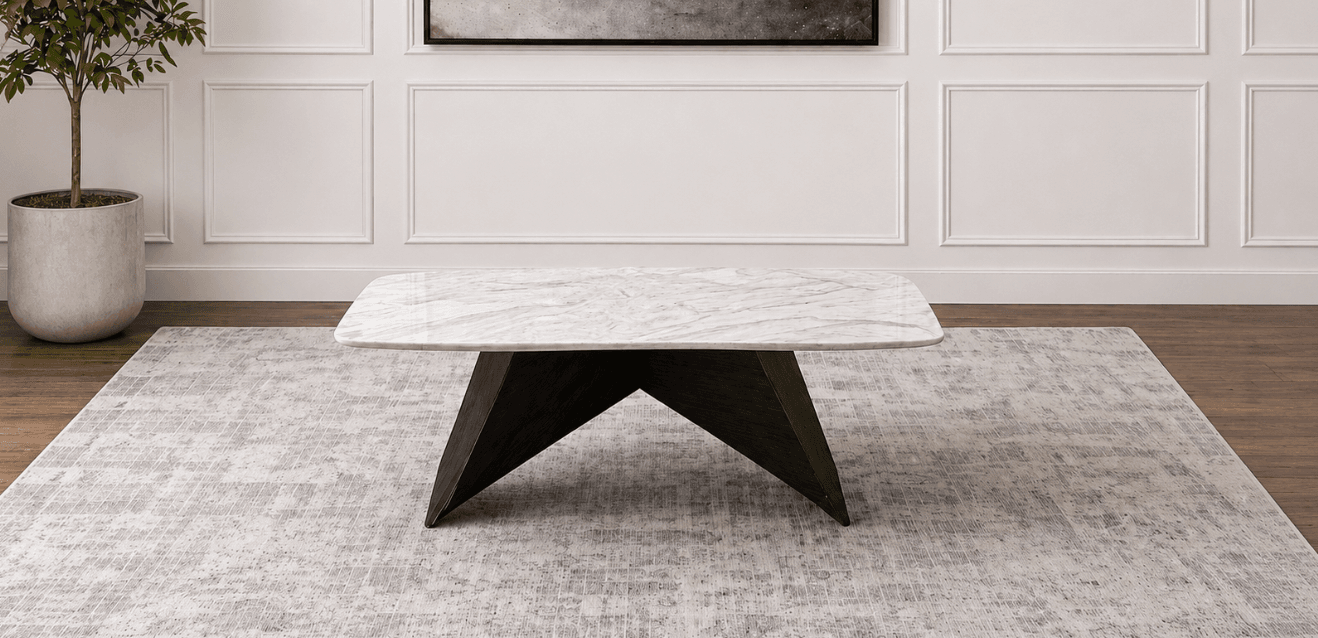
A coffee table looks like the easiest piece of furniture in the living room to buy. It rarely is. Get the size wrong and a sofa that fit the room perfectly suddenly feels cramped, or the table sits stranded in the middle of the floor with acres of dead space around it. Get the height wrong and every guest ends up either hunching forward or reaching up for their drink. None of this is about taste - it is about proportion, and proportion follows rules that are easy to apply once you know them.
This guide walks through the measurements that actually matter: how big a coffee table should be relative to your sofa, how tall it should sit, how much clearance to leave around it, which shape suits which room, which materials hold up to real family use, and when a lift-top or storage table is worth the extra cost. Bring a tape measure - most of this guide only takes five minutes to apply once you have your sofa's dimensions in hand.
How Big Should a Coffee Table Be? The Two-Thirds Rule
The single most useful rule in coffee table shopping is this: the table should run roughly two-thirds the length of the sofa it sits in front of.
A 90-inch sofa - a common length for a three-seat piece - pairs well with a coffee table somewhere between 54 and 66 inches long. A smaller loveseat around 60 inches wants a table closer to 36 to 42 inches. Go much shorter than two-thirds and the table reads as an afterthought, lost in front of a large sofa. Go much longer and it starts to compete with the sofa rather than sit in front of it.
Width follows a similar but looser rule: aim for the table to be somewhere between half and two-thirds of the sofa's width, or, for a round or square table, roughly that same proportion of the sofa's depth. A table that is too narrow disappears visually. One that is too wide starts eating into the walking space on either side.
If you are shopping for a sectional rather than a straight sofa, measure the depth of the main seating run in front of the table, not the full footprint including the chaise. A large sectional does not necessarily need a giant coffee table - it needs a table sized to the section of it people are actually sitting in front of.
Quick reference for common sofa lengths:
- 60-inch loveseat: 36 to 42 inch coffee table
- 72-inch sofa: 42 to 50 inch coffee table
- 84-inch sofa: 50 to 58 inch coffee table
- 90 to 96-inch sofa: 54 to 66 inch coffee table
- Large sectional (seating run 100+ inches): consider two smaller tables, or one large rectangular or oval table sized to the main seating run rather than the full sectional footprint
Browse our coffee table collection with these ranges in hand and the right size narrows quickly.
Getting the Height Right
Height gets less attention than length, but it matters just as much for comfort. The rule of thumb is straightforward: your coffee table should sit level with your sofa's seat cushion, or up to two inches lower.
Most sofas measure 17 to 19 inches from the floor to the top of the seat cushion, which is why the vast majority of coffee tables land somewhere in the 16 to 19 inch range. A table taller than your seat height forces you to reach up and across for a drink or a plate. A table dramatically lower than seat height means leaning down and forward, which gets uncomfortable fast if you are using the table while seated for any length of time.
If you already own the sofa, there is a simple test: sit down in your normal spot and mime picking up a mug from the table's intended position. If your elbow lifts awkwardly high, the table is too tall. If you have to hunch forward more than feels natural, it is too low. The motion should feel like reaching across a desk, not reaching for a shelf.
One exception worth knowing about: some newer coffee tables are built taller, in the 18 to 20 inch range, specifically to double as a casual work surface for a laptop. If you regularly work from the sofa, that slightly taller profile is worth considering - just check it still sits within two inches of your seat height so it does not feel out of place for everyday use.
How Much Clearance to Leave Around It
Clearance is where most living rooms go wrong, usually by buying a table that is the right size on paper but leaves no room to actually live around it.
Leave 16 to 18 inches between the front edge of your sofa and the near edge of the coffee table. That is enough room to stretch your legs out comfortably and still reach the table without leaning far forward. Less than 14 inches starts to feel tight for anyone with longer legs; more than 20 inches and the table starts to feel disconnected from the seating around it.
Walkways around the table need more room than the sofa-to-table gap. Any path people regularly walk - from the entry to the kitchen, say, or around the table to a window - benefits from at least 30 inches of clear width, and 36 inches is more comfortable if the route sees regular traffic or gets used by anyone with a stroller, a cane, or simply an armful of grocery bags. This is close to the clearance the U.S. Access Board's guidance on accessible routes recommends for general circulation paths - not a code requirement for a private home, but a useful benchmark for a route that needs to work for everyone who visits.
If your living room is small enough that hitting both the 16 to 18 inch sofa clearance and a 30-inch walkway is a genuine squeeze, prioritize the walkway. A living room you have to sidestep through every day gets tiring fast; a coffee table sitting a couple of inches closer than ideal rarely gets noticed.
Round vs Rectangle: Choosing a Shape for the Room and the Traffic Path
Shape is partly aesthetic and partly practical, and the practical side should usually win.
Rectangular and oval tables suit long, straight sofas and larger rooms. They fill a long sightline in front of a sofa without looking undersized, and a rectangular table lines up naturally with a rectangular rug and a rectangular room. In a larger space with generous walkways, a rectangle is often the better-looking choice.
Round and oval tables work best where traffic flows around the table on more than one side, or where the room is tight enough that sharp corners become an actual hazard rather than just a style note. A round table has no corners to catch a hip or a shin walking past, and because it has a smaller overall footprint than a rectangle of the same "size," it tends to make a compact room feel less crowded. If the space between your sofa and anything else in the room already feels snug, a round or oval table is usually the safer call.
Square tables sit between the two. They suit L-shaped sectionals and squarer rooms, and pair naturally with a pair of matching armchairs facing a sofa across a square footprint.
A short way to decide: if people only ever approach the table from one side (the sofa side), a rectangle or oval usually looks best. If people walk around it regularly, from multiple directions, lean round.
Choosing a Material That Survives Real Life
Coffee tables take more daily abuse than almost anything else in a living room - drinks, feet, remotes, kids' homework, the occasional pet. Material matters more here than it does on a piece people only look at.
Solid wood is the most forgiving everyday material. It handles daily use well, and light surface scratches on solid wood can usually be sanded and refinished rather than living with permanently. For a household with young kids or pets that uses the living room every day, wood is generally the lowest-maintenance choice long-term.
Marble gives a table real visual weight and handles heat well, but it is a porous stone. Spills from wine, coffee or citrus can stain if left sitting, and a sharp impact can chip an edge. According to the Natural Stone Institute, sealing slows staining but does not prevent etching - the dull marks left by acidic spills - since that reaction happens right on the surface. A sealed marble top in a household that wipes up spills promptly holds up fine; one that regularly sits with a wine glass on it overnight will show it eventually.
Glass is easy to clean and visually light, which suits smaller rooms, but it shows fingerprints and dust more than any other material and is the least forgiving of a hard knock. It is worth a harder look in a home without small children, and a more cautious one in a home with them.
Metal frames, especially powder-coated ones, are close to maintenance-free and shrug off daily wear better than any of the above. Most metal coffee tables pair the frame with a wood, glass or stone top, so the real durability question usually comes down to whichever top material you choose alongside it.
None of this means picking the "toughest" material and ignoring everything else - it means matching the material to how the room actually gets used. A formal, rarely-used front room can carry a marble or glass top beautifully. A family room where three people eat dinner off the coffee table most weeknights is a better fit for wood or a durable laminate.
Lift-Top and Storage Coffee Tables: Worth It?
Lift-top coffee tables raise the tabletop to counter or desk height, turning the table into a laptop stand or an eating surface without anyone leaving the sofa, and most also hide storage underneath for blankets, remotes and the general clutter that collects in a living room.
They are worth considering if you regularly eat, work or take calls from the sofa, or if hidden storage would genuinely solve a clutter problem in your living room. They are less worth it if you mainly want the look of a lift-top without using the mechanism - it adds weight, moving parts and (eventually) a hinge that may need attention, none of which you want to pay for if it is not going to get used.
A few practical notes if you are considering one: check the lifted surface can support at least 30 to 50 pounds without flexing, since a laptop and a plate together add up faster than people expect. A larger lifted surface, in the 43 to 47 inch range, works better if you plan to actually eat meals on it; a smaller one is fine for occasional laptop use. Our smart coffee table is a straightforward example of the category if you want to see the mechanism in person before deciding.
If you like the idea of hidden storage but do not need the lift function, a coffee table with a shelf, drawer, or closed cabinet base gets you most of the benefit with fewer moving parts to maintain.
Coffee Table or End Tables - or Both?
A coffee table and a pair of end tables solve slightly different problems, and most living rooms benefit from having both rather than choosing one over the other.
The coffee table is the shared surface - the one everyone in the room can reach, used for drinks, board games, a shared plate of appetizers, the remote. End tables sit beside the arms of a sofa or an armchair and give each seat its own personal surface, close enough to set down a phone or a glass without leaning forward at all.
If your living room only has space for one, the coffee table generally does more work and should come first. Once the seating and the coffee table are placed, end tables are worth adding wherever there is a gap beside a sofa arm or an armchair that currently has nowhere nearby to set anything down. Keep end tables roughly level with the arm of the sofa or chair next to them, rather than matching the coffee table's height - the point of an end table is reaching sideways without looking down.
Coffee Tables in Smaller Edmonton Living Rooms
Condos, infills and older walk-ups around Edmonton often mean a living room with less floor area to work with, and the coffee table is usually the piece that has to give up the most ground to make everything else fit.
In a tight room, a round or oval table earns its keep twice over: it has a smaller physical footprint than a rectangle of comparable length, and it removes the corners that make a snug walkway feel snugger. A nesting set is another option worth considering in a small space - one surface most of the time, pulled apart into two or three when guests are over, and stacked back down when they are not.
For a fuller look at furnishing a smaller Edmonton home - depth over length, traffic paths before furniture, and pieces that do two jobs - see our guide to furnishing a small space in Edmonton.
Bringing It Together
A quick checklist before you buy:
- Length: roughly two-thirds your sofa's length
- Height: level with your seat cushion, or up to two inches lower
- Clearance: 16 to 18 inches between the sofa and the table's near edge
- Walkway: at least 30 inches of clear width on any route people regularly walk
- Shape: rectangle or oval for a long, straight sofa in a larger room; round or oval where traffic passes on multiple sides or the room is tight
- Material: matched to how hard the room actually gets used, not just how the table looks in a photo
Measurements get you most of the way there, but seeing scale in person is still the best way to confirm a decision, especially on height and material. Our showroom at 14721 123 Ave NW has a working range of sizes, shapes and materials on the floor, and our team can talk through what will actually fit your room - bring your sofa's dimensions and a photo if you have one. Browse the full living room collection online first, pair a new table with one of our sectional sofas if you are furnishing the whole room at once, or ask about payment options when you visit. You can also plan a visit through our showroom page for hours and directions.
FAQ
How big should a coffee table be compared to my sofa?
Aim for roughly two-thirds the length of your sofa. A 90-inch sofa suits a table between 54 and 66 inches long; a 60-inch loveseat suits one between 36 and 42 inches. Width should land somewhere between half and two-thirds of the sofa's width, or the equivalent proportion of its depth for a round or square table.
What is the standard coffee table height?
Most coffee tables sit 16 to 19 inches tall, matching the seat height of a typical sofa. The rule of thumb is level with your seat cushion or up to two inches lower, so reaching for a drink feels like reaching across a desk rather than up to a shelf or down to the floor.
Should I choose a round or a rectangular coffee table?
Rectangular and oval tables suit long, straight sofas and larger rooms with a clear sightline. Round and oval tables work better where people walk around the table from more than one side, or where the room is tight enough that sharp corners get in the way. When in doubt in a smaller space, round is the safer choice.
Is a lift-top coffee table worth it?
It depends on how you actually use your living room. If you regularly eat, work or take video calls from the sofa, or hidden storage would solve a real clutter problem, a lift-top pays for itself. If you like the look but would not use the mechanism, a table with a simple shelf or drawer gets you most of the benefit with fewer moving parts.
Do I need both a coffee table and end tables?
Most living rooms benefit from both. The coffee table is the shared surface everyone in the room can reach; end tables give each seat beside a sofa arm or armchair its own nearby surface. If space only allows one, start with the coffee table and add end tables wherever there is a gap beside the seating.
Which coffee table material holds up best with kids or pets?
Solid wood is generally the most forgiving for daily family use - it takes wear well and light scratches can usually be sanded out. Marble and glass look striking but need more care: marble can stain or etch from spills, and glass shows fingerprints and dust more readily. Metal frames are close to maintenance-free, though the top material paired with them still matters most.


