What's Included in a Bedroom Set (and What to Buy Separately)
A clear breakdown of what 3- to 6-piece bedroom sets include, what counts as the bed, and what to budget for separately before you order.
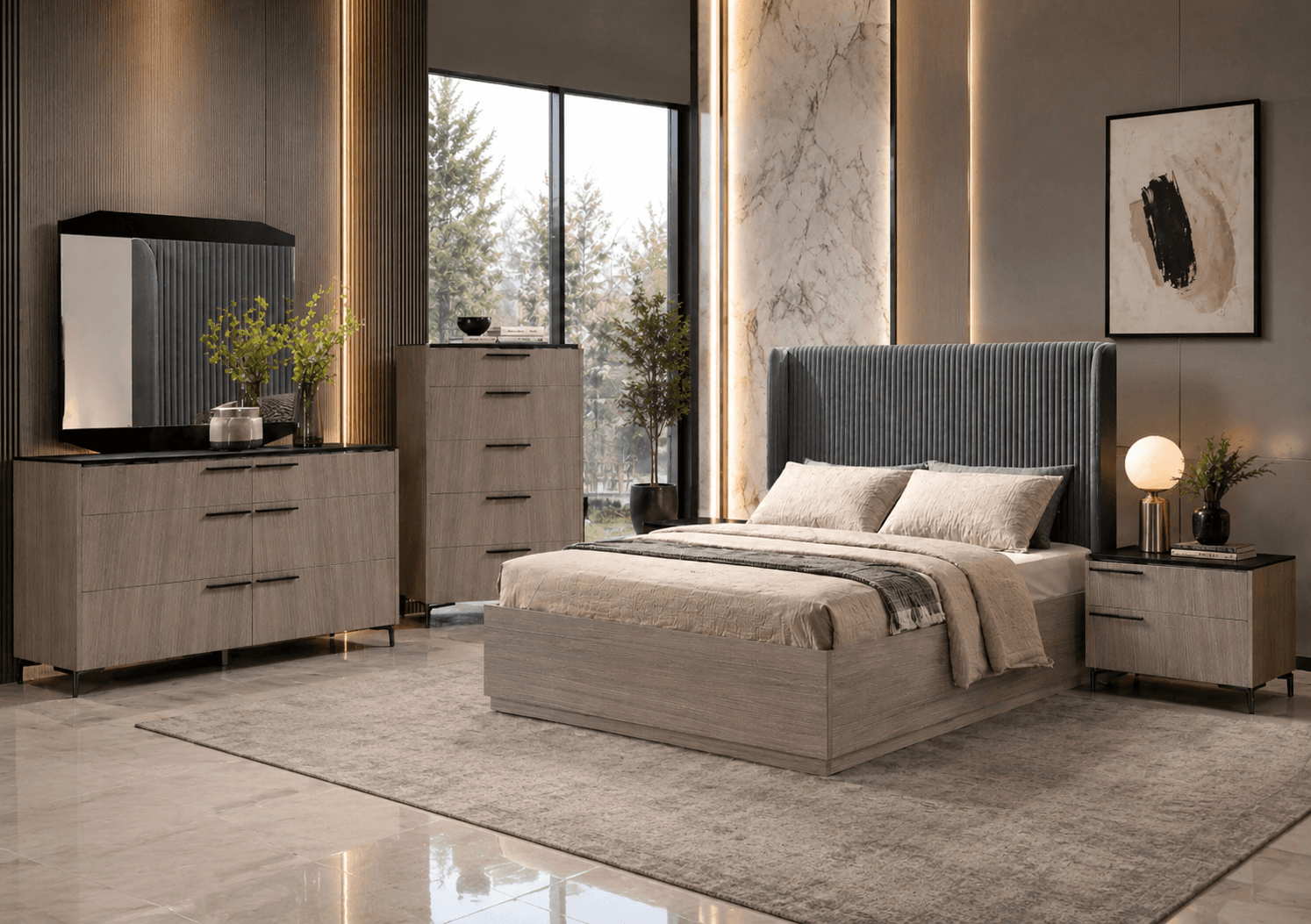
"Bedroom set" is one of the most-searched phrases in furniture shopping and one of the least standardized. Walk into three different stores and ask what a "bedroom set" includes, and you will likely get three different answers - sometimes for the exact same number of pieces. One retailer's four-piece set might mean a bed, dresser, mirror and one nightstand. Another's four-piece set swaps the mirror for a second nightstand. Neither is wrong; there simply is no industry-wide rule.
That ambiguity causes real problems at checkout. Shoppers assume a mattress is included when it almost never is. They assume "the bed" means a complete, ready-to-sleep-on frame when it sometimes means just a headboard. They order a set sized for a primary suite and it turns out to be tight for a smaller spare room, because nobody checked the clearances first.
This guide breaks down what a bedroom set actually contains piece by piece, what counts as "the bed" versus what gets sold separately, how to judge whether a matched set or a mixed one is the better call, and how to confirm a set will physically fit your room before it arrives on a truck. The goal is simple: know exactly what you are buying before you buy it.
What "Bedroom Set" Actually Means
A bedroom set is a group of coordinating furniture pieces - typically built in the same material, finish and hardware style - sold together as a package rather than chosen one piece at a time. The appeal is straightforward: everything is designed to match, it is usually simpler to shop, and a packaged set can work out to better value than assembling the same look piece by piece.
The confusion starts with the word "set" itself. There is no regulatory body or industry association that defines what a 3-piece or 5-piece bedroom set must contain. Each retailer decides its own packaging, which means the piece count on a listing is a starting point for your research, not the full answer. The only reliable way to know what you are getting is to read the specific list of included items on that specific listing, every time, even if you have bought a "5-piece set" before.
Piece Counts Explained: 3, 4, 5 and 6-Piece Sets
With that caveat in mind, here is how piece counts most commonly break down across the furniture industry, from smallest to largest:
3-piece set. Usually the bed, a dresser and one nightstand, though some retailers substitute the dresser's mirror as the third piece instead of a nightstand. This is the entry point for smaller rooms or a guest bedroom where storage needs are modest.
4-piece set. Commonly the bed, dresser, mirror and one nightstand - or alternatively the bed, dresser and two nightstands with no mirror. Because this configuration varies the most between retailers, it is the piece count most worth double-checking item by item before you order.
5-piece set. Typically the bed, dresser, mirror and two nightstands. This is the most common configuration for a primary bedroom shared by two people, since it accounts for a nightstand on each side of the bed.
6-piece set. Usually the 5-piece configuration plus a chest of drawers (sometimes called a highboy or tallboy) for additional storage. Some 6-piece sets substitute a bench, armoire or trunk for the chest instead, so check which piece fills that sixth slot.
None of these configurations is "correct." A 3-piece set with a well-chosen nightstand and dresser can furnish a bedroom just as completely as a 6-piece set, depending on what storage the room already has - a closet system, a hallway linen cabinet, built-in shelving. Before you size up to a bigger set for more pieces, consider whether you actually need the extra storage or whether it will crowd a room that does not have the floor space for it.
What's Actually Inside "The Bed"
This is the single most common point of confusion in bedroom set shopping, because "the bed" as a line item can mean several different things depending on the retailer and the style.
A complete bed frame typically includes:
- Headboard - the panel at the head of the bed, which can be upholstered, wood, or a mix of materials.
- Footboard - a matching panel at the foot of the bed. Many modern platform styles skip this entirely for a cleaner, lower-profile look.
- Rails - the side pieces that connect the headboard and footboard and support the mattress platform.
- Slats or a center support beam - the horizontal pieces (and, on larger sizes, a center leg) that carry the actual weight of the mattress and sleeper.
What a bed almost never includes is the mattress itself. Bedroom sets are built and priced around the furniture, not the mattress, which is typically sold as a completely separate purchase - and often from a different supplier entirely, since mattress construction is its own specialized category. If a listing does not explicitly say "mattress included," assume it is not, and budget for it as a separate line item.
Box spring needs depend on the bed style. According to the Sleep Foundation's guide on mattress foundations, platform beds generally do not need a box spring because the frame's slats or solid base already provide the mattress support, though it is worth confirming with the mattress manufacturer that a specific mattress is rated to work without one - using the wrong foundation can affect a mattress warranty. Traditional frames built for a box spring, by contrast, usually need one to reach a comfortable height and to properly support an innerspring mattress. If you already own a mattress and are shopping for a new bed, check which category your mattress falls into before you decide on a frame style.
Platform Bed or Traditional Frame: What Changes
Beyond the box-spring question, platform and traditional frames differ in a few other practical ways worth knowing before you choose:
Height. Platform beds typically sit lower to the floor, which tends to suit lower-ceilinged rooms and gives upholstered headboards more visual presence. Traditional box-spring frames sit higher, which some people prefer for easier getting in and out of bed.
Under-bed storage. Many platform frames are built with the slats raised enough to leave room for storage bins or drawers underneath - genuinely useful in a smaller room or a condo without a second closet. A traditional frame with a box spring usually leaves less usable clearance underneath.
Mattress compatibility. Platform frames with closely spaced slats generally work well with memory foam, latex and hybrid mattresses, which need continuous, even support rather than the flex a box spring provides. Traditional innerspring mattresses are more commonly paired with a box spring or rigid foundation. If you are mixing an existing mattress with a new frame, this is worth confirming rather than assuming.
Neither style is objectively better - it comes down to the room, the mattress you already own or plan to buy, and whether under-bed storage matters to you.
What's Never Included (Even in a Complete Set)
A few items are consistently left out of bedroom sets, regardless of piece count or retailer, and it is worth planning for them separately from the start:
- Mattress. As covered above, this is sold separately essentially everywhere.
- Bedding. Sheets, pillows, duvets and comforters are a styling and sizing decision made after the furniture arrives, not part of the furniture purchase.
- Lighting. Table lamps for the nightstands, and any overhead or wall fixtures, are treated as a separate category even when a showroom display shows them styled together.
- Area rugs and window treatments. The same logic applies - these finish a room but are not part of what "bedroom set" refers to as a furniture category.
Mentally separating "the furniture package" from "everything else that finishes the room" makes it much easier to budget accurately and avoid an unpleasant surprise when the invoice does not include a lamp you assumed came with the nightstand.
Buying a Matched Set vs Mixing and Matching
A matched set - everything from the same collection, same finish, same hardware - is the simplest way to furnish a bedroom with a cohesive look in one decision. It also tends to be easier to plan around, since the dimensions of each piece are designed to work together from the start.
Mixing pieces from different collections is a legitimate approach too, and it is how a lot of considered, less showroom-like bedrooms are actually put together. A few practical guardrails make mixed rooms work rather than feel accidental:
Repeat at least one element. A dark wood headboard reads as intentional next to a dresser in a similar tone, even if the overall silhouettes are different. Matching metal finishes on hardware - handles, legs, lamp bases - is another easy way to tie pieces together without matching everything else.
Watch sheen as closely as color. A glossy modern piece sitting next to a matte, textured one can clash even when the wood tones are genuinely close. If you are shopping across collections, compare pieces in person rather than from photos, where sheen differences are hard to judge.
Limit the number of distinct wood tones in one room. Two or three tones generally still read as a considered palette; stacking many different finishes in a single small room tends to look accidental rather than curated, simply because the eye has nowhere to land.
Use a neutral piece to bridge contrast. A painted or upholstered nightstand can sit between two different wood tones - the bed frame and the dresser, say - without forcing either one to match exactly.
If you are furnishing in stages rather than all at once, mixing is often the more practical route anyway, since it does not depend on a specific collection still being available months or years later.
Will It Fit? Measuring Your Room Before You Buy
A bedroom set that looks proportionate in a showroom or product photo can feel cramped once every piece is actually in your room with real walking space subtracted. A few measurements, taken before you order rather than after delivery, prevent most of this.
Clearance around the bed. According to Homes & Gardens' guide to bedroom clearances and spacing, a comfortable walkway on the sides of the bed generally needs at least 24 to 30 inches, with wider paths preferred for the main route in and out of the room. Tighter than that, and the room starts to feel like an obstacle course rather than a place to move around comfortably - worth remembering in an Edmonton home where a smaller secondary bedroom is common.
Clearance for drawers. A dresser needs enough open floor in front of it for the drawers to fully extend and for someone to stand there while using them - closer to 30 to 36 inches is the more comfortable target, especially for a dresser placed directly across from the foot of the bed.
Standard bed and mattress sizes. If you are not certain which size fits your frame, Houzz's guide to key bedroom measurements is a useful reference for standard mattress dimensions by size, which is worth checking against your existing bedding and mattress before ordering a new frame.
Doorways and hallways. Headboards and footboards are frequently the piece most likely to get stuck on a tight turn, particularly in older homes with narrower upstairs hallways or a tight stairwell. Measure the doorway, the hallway width, and any turns the piece needs to clear - not just the final room - before you order.
Ceiling height for tall headboards. A dramatic, tall upholstered headboard can visually overwhelm a room with lower ceilings. If your ceilings run on the lower side, a platform frame with a shorter headboard generally reads better in the room than a towering one.
Bring these measurements with you to the showroom, along with a photo of the room if you have one - it genuinely speeds up the conversation and avoids ordering something that needs to be measured again after the fact.
Delivery, Assembly and What to Ask Before You Order
Once a set is ordered, a few practical questions upfront make delivery day go more smoothly:
Does delivery include assembly? Trendz Furniture offers white-glove delivery across Edmonton and Alberta, starting at $199 outside Edmonton. Ask specifically whether that includes in-room placement and assembly, or whether assembly is a separate step - practices vary by retailer, and it changes how much you need to plan for on delivery day.
Is the path clear? Measure and clear the route the furniture needs to travel before the delivery team arrives, including stairwells, tight turns and any furniture currently blocking the path. If you are replacing an existing bed, plan to have it moved out ahead of time, since a delivery crew is typically there to bring in the new pieces, not remove old ones.
What is the realistic timeline? Lead times vary by item and by whether a piece is in stock or special order, so ask for a specific estimate on the exact set you are considering rather than relying on a general range.
What are the payment options? Pricing and payment options at Trendz are discussed directly with the showroom team, since availability and terms vary by product and by customer - it is worth having that conversation before you commit to a specific set so there are no surprises at checkout.
What is the return policy if a piece does not fit? Review the shipping and returns policy before you order, particularly for special-order finishes, which are often handled differently from in-stock items.
A Simple Bedroom Set Buying Checklist
Before you order, confirm:
- The exact list of pieces included at your chosen piece count - read the listing, do not assume from the number alone.
- Whether "the bed" includes a headboard, footboard, rails and slats, or only some of those pieces.
- Whether a box spring is required, recommended, or unnecessary for the specific frame and your mattress.
- That a mattress, bedding and lighting are budgeted as separate purchases.
- Room measurements against the set's dimensions, including walkway clearance and drawer swing.
- Doorway, hallway and stairwell measurements for the largest piece, especially the headboard.
- Whether delivery includes assembly, and what the realistic timeline looks like for your specific pieces.
A bedroom set is one of the larger furniture purchases most people make, and most of the frustration that comes with it traces back to an assumption that turned out to be wrong - about what was included, what would fit, or what still needed to be bought separately. Working through the list above before you order turns most of those assumptions into confirmed facts instead.
If you want to see full sets in person, our Edmonton showroom has several configurations set up to walk through, and our bedroom collection online is a good starting point for browsing by style. For the style side of the decision, our guides to choosing a luxury platform bed and the bedroom trends we're seeing in Edmonton homes this year go deeper into finish and headboard choices once you know what pieces you actually need. You can also browse the full shop or check our FAQ page for other common questions before you visit.
FAQ
Does a bedroom set include the mattress?
Almost never. Bedroom sets are priced and sold as furniture packages, and the mattress is treated as a separate purchase in nearly every case. If a listing does not explicitly state that a mattress is included, assume it is not and budget for it separately.
What is the difference between a 4-piece and 5-piece bedroom set?
There is no universal rule, but a 4-piece set commonly includes the bed, dresser, mirror and one nightstand, while a 5-piece set typically adds a second nightstand - useful when two people share the bed and each wants a nightstand on their own side. Always check the specific item list on the listing you are considering, since this varies by retailer.
Do I need a box spring with a platform bed?
Generally no. Platform beds are built with slats or a solid base that already supports the mattress, so a box spring is usually unnecessary and can even raise the bed higher than intended. It is still worth confirming with your mattress manufacturer that your specific mattress is designed to work without one, since using the wrong foundation can affect a mattress warranty.
Can I mix bedroom furniture from different collections instead of buying a matched set?
Yes, and it is a common, intentional design choice rather than a compromise. The pieces read as coordinated, rather than mismatched, when you repeat at least one shared element - a wood tone, a metal finish, or matching hardware - across the room, and when you keep sheen levels (matte versus glossy) reasonably consistent between pieces.
How much clearance does a bedroom need around the bed?
As a general guideline, aim for at least 24 to 30 inches of walkway on the sides of the bed you need to access, and closer to 30 to 36 inches in front of a dresser so the drawers can fully open and someone can comfortably stand there. Tighter secondary bedrooms may need to work with the lower end of that range.
Does Trendz Furniture's delivery include assembly for a full bedroom set?
White-glove delivery is available across Edmonton and Alberta, starting at $199 outside Edmonton. Ask our showroom team to confirm exactly what is included for your specific set, since the scope of in-room placement and assembly can vary by item.


