How to Choose a Reclining Sofa in Edmonton
Manual or power, the clearance people get wrong, what actually breaks, and which reclining configurations suit Edmonton living rooms.
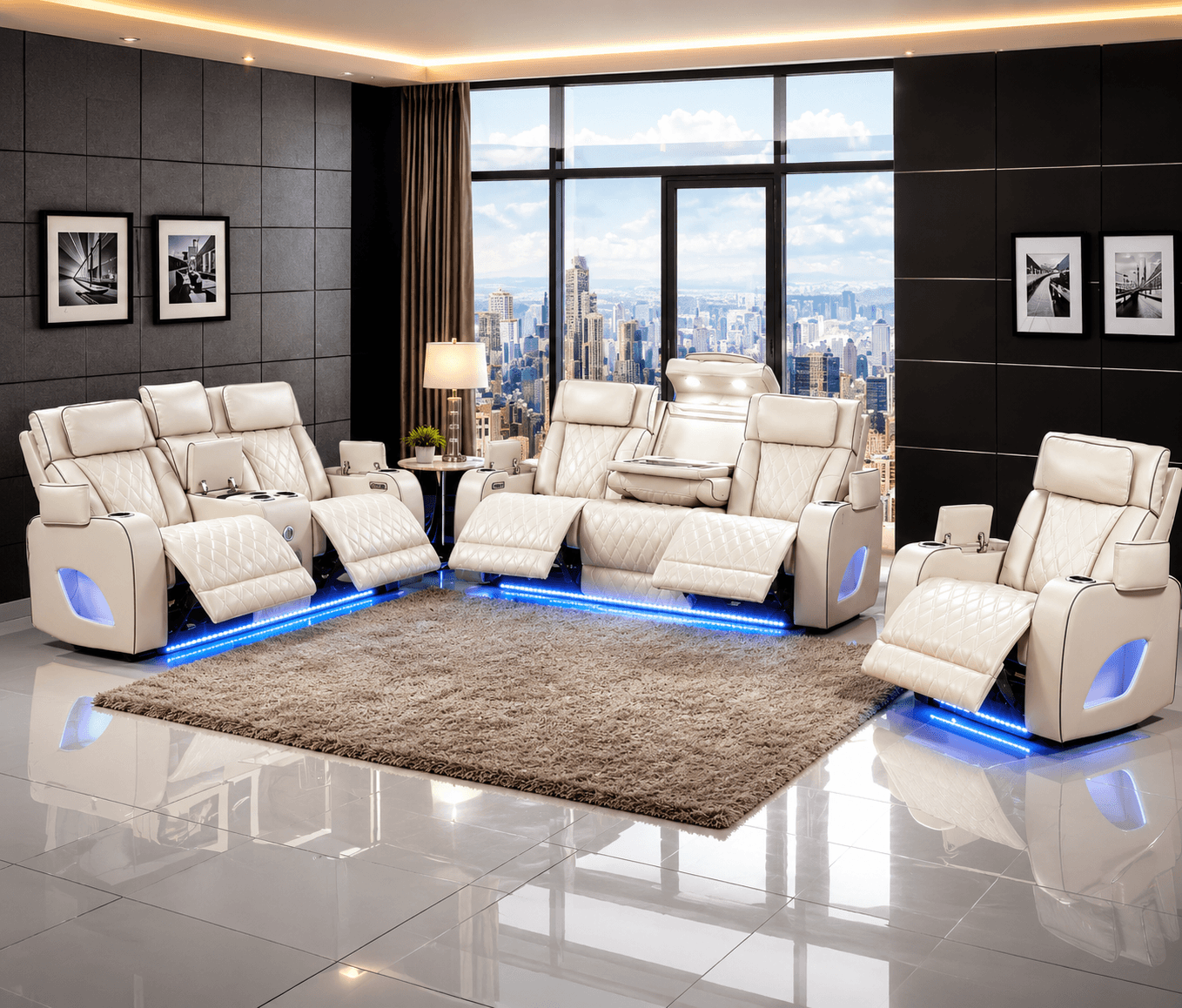
The reclining sofa has quietly become the most-bought piece of living room furniture in Edmonton, and it is not hard to see why. We spend a long winter indoors, the television is on more months than it is off, and the difference between a sofa you sit on and a sofa you settle into is felt every single evening from October through April.
What has changed is that reclining furniture no longer looks like reclining furniture. The overstuffed brown monolith of twenty years ago has been replaced by pieces with slim arms, tailored stitching and hidden mechanisms that read as a normal sofa until someone reaches for the button. This guide covers how to choose one well: manual against power, what actually breaks, how much clearance you really need, and how to fit one into an Edmonton room without the room becoming a home theatre.
Manual or power - the decision that matters most
Almost every other choice follows from this one.
Manual reclining uses a lever or a push-back mechanism. There is nothing to plug in, nothing to fail electronically, and the mechanism is simple enough that it will generally outlast the upholstery. The trade-off is that reclining takes a deliberate physical motion, which is harder from a seated position for anyone with limited shoulder or core strength, and the positions are fixed - you get upright, partial, and full, with nothing in between.
Power reclining uses a motor and a button. It stops anywhere in the range, which matters more than people expect: the ideal position for reading is not the ideal position for watching a film, and a manual recliner cannot hold the difference. Power units also make the furniture genuinely usable for people who would struggle with a lever, which is often the deciding factor in a multi-generational household.
The honest downsides of power are that it needs an outlet within reach, and that a motor is one more component that can fail. In practice the motors are reliable and replaceable, and most units carry a separate warranty from the frame. The bigger practical issue is the cord: plan where it runs before delivery day, not after.
If the piece will sit against a wall with an accessible outlet and more than one person will use it, power is usually worth it. If it is a secondary room, a basement, or a spot with no convenient power, manual is the sensible choice.
Our recliner sofas include both, and the difference is best judged by trying each rather than reading about it.
Clearance - the measurement people get wrong
This is where more recliner purchases go wrong than anywhere else.
A reclining sofa needs space behind it to open. Traditional mechanisms need substantial clearance - often a foot or more between the back of the sofa and the wall. Wall-hugger designs, sometimes called zero-wall or wall-saver, slide the seat forward as the back tilts, and need only a few inches. The difference determines whether a recliner works in your room at all.
Measure three things before you shop:
- Behind the sofa. The gap you can accept between the back and the wall.
- In front. A reclining footrest extends further than people picture, often close to two feet from the front edge. If that lands in a walkway or on a coffee table, the sofa is unusable in its most-used position.
- The path in. Doorway width, the tightest staircase turn, and elevator dimensions if you are in a condo. Reclining frames are heavier and less flexible than standard sofas, and the mechanism means they cannot be compressed the way a standard frame sometimes can.
In a Glenora or Highlands home with a defined living room and a doorway rather than an opening, the path in is often the binding constraint rather than the room itself. In a Windermere or Terwillegar great room, the constraint is usually the walkway in front. Tell us the tight spot when you order and we will plan the delivery around it.
What actually breaks, and what to look for
Reclining furniture has moving parts, so the failure points are different from a static sofa. Three things are worth asking about specifically.
The mechanism. Steel mechanisms outlast the composite ones used in entry-level pieces. Ask what it is made of and whether the mechanism carries its own warranty separate from the frame - a manufacturer confident in the mechanism will warrant it separately.
The frame at the stress points. A reclining sofa concentrates force where the mechanism mounts. Kiln-dried hardwood at those points is what stops the frame loosening into a wobble by year four. Softwood or particle board at the mount is the single most common reason a cheap recliner develops a creak that cannot be fixed.
The seat foam. Recliners get more concentrated use than standard sofas because everyone sits in the same spot. High-resilience foam over a supportive base holds up; low-density foam develops a permanent depression. This is the difference you feel in year three, not on the showroom floor.
Our Fortuner in black, Supra in brown and Duke in brown are the three we point most Edmonton buyers toward for exactly these reasons - the construction is where the money went rather than the appearance.
Leather or fabric on a recliner
The material question is slightly different on reclining furniture than on a static sofa, because the contact points move.
Leather is the traditional choice and it suits recliners well. It wipes clean, it does not trap odour, and the flex points develop a patina rather than wearing thin. The Edmonton caveat is the one that applies to all leather here: our winter indoor humidity drops low enough to dry the hide over years, so a recliner within a few feet of a heat register needs conditioning two to four times a year. Our note on caring for leather furniture through prairie winters covers the routine.
Performance fabric is warmer to the touch in January, more forgiving of scratches, and easier to live with if pets share the sofa. The trade-off is that the seams and flex points on a recliner see more abrasion than on a static piece, so a fabric with a low rub count wears at the edges first. Ask for the rating.
Bonded or corrected leather is worth understanding before you buy. It looks like full leather in a photograph and costs considerably less, but it behaves differently at the flex points over time. On a recliner, where those points move thousands of times a year, that distinction shows up sooner than it would on a static sofa.
Configurations that work in Edmonton rooms
Reclining furniture is sold in more configurations than standard seating, and the right one depends on the room rather than the budget.
Reclining sofa plus a matching chair is the most common arrangement and works in most defined living rooms. It gives two prime reclining seats plus a third for guests.
Reclining loveseat with a console puts two recliners side by side with storage and cup holders between. In a smaller room, or a basement family room, this is often the better buy than a full sofa - two people get the good seat instead of competing for the ends.
Reclining sectional suits the open great rooms in newer builds where the seating has to define the space rather than line a wall. Watch the clearance carefully here, because a sectional corner cannot be pulled away from the wall the way a sofa can.
Single recliners paired with a standard sofa is the underrated option. You get the reclining seat without committing the whole room to reclining furniture, and the room reads as a living room rather than a theatre. For anyone worried a recliner will make the space look heavy, this is usually the answer.
If the room is doing double duty as a family space and a room you would receive guests in, our sectional sofas paired with one or two recliners is worth considering against a full reclining set.
Living with a recliner day to day
A few practical things nobody mentions until after delivery.
Cup holders and consoles are genuinely useful and also collect crumbs. Check whether the console tray lifts out for cleaning; the ones that do not become permanently grubby.
Powered units need the cord managed. Run it behind the piece to the nearest outlet before you position the sofa properly, and check that the cord is not pinched by the mechanism at full recline.
Vacuum into the mechanism area every few weeks. Crumbs and pet hair migrating into the moving parts is the most common cause of a mechanism starting to catch, and it is entirely preventable.
If the recliner sits on hardwood, felt pads under the feet stop the piece walking across the floor when the footrest deploys. This sounds trivial until a heavy recliner has scuffed a line into a floor over a winter.
Fit matters more on a recliner than on a sofa
A static sofa forgives a poor size match; a recliner does not. Because the piece positions your whole body rather than just supporting your back, small mismatches become nightly irritations.
Seat depth decides whether your lower back reaches the lumbar support. If the seat is too deep, you either perch forward and lose the backrest entirely or slide down into a slouch. Too shallow and the seat edge catches behind the knee. This varies enormously between models that look almost identical.
Headrest position is the one most people discover too late. At full recline, the headrest should meet the back of your head, not the top of your shoulders or the crown. A headrest tuned for someone five foot four sits wrong for someone over six feet, which is why a couple with a significant height difference should both try the same piece before buying. Some power units add an adjustable headrest specifically to solve this, and in a mixed-height household it is worth the premium.
Footrest length should support the calf through to the ankle. A footrest that stops mid-calf leaves the feet dangling and puts pressure exactly where circulation is worst - the most common complaint we hear about recliners bought without sitting in them.
Arm height determines whether your shoulders sit level or hunched. Test it with your arms resting naturally rather than placed deliberately.
The practical advice: sit in the piece for several minutes in the position you would actually use, not upright for ten seconds. Bring whoever else will use it regularly, and try it wearing what you would normally wear at home, because a thick winter sweater changes how the lumbar curve meets your back more than you would expect.
A short buying checklist
- Decide manual or power first; everything follows from it.
- Measure behind, in front, and the path in - all three.
- Confirm whether it is a wall-hugger if space behind is tight.
- Ask what the mechanism is made of and whether it is warranted separately.
- Ask about frame material at the mechanism mounting points.
- Check the foam density in the seat.
- If power, confirm the outlet position before delivery day.
- Sit in it for more than a minute, in the position you would actually use.
Try them at our west Edmonton showroom
A reclining sofa is the piece least suited to buying online, because the entire point is how it feels at full extension with your own height and build. Seat depth that suits one person leaves another perched; a headrest angle that is perfect at five foot four is wrong at six foot two.
Come try them at 14721 123 Ave NW in west Edmonton. Recline them fully, check the lumbar position, and see whether the footrest lands where your legs actually are. Browse the recliner sofas or the full living room collection before you visit, arrange flexible financing in person, or get in touch with a question. White-glove delivery covers Edmonton and Alberta, starting at $199 outside Edmonton, and our crew handles the assembly and positioning.
FAQ
Is a power recliner better than a manual one?
Neither is universally better. Power stops at any position in the range, which matters because the best angle for reading differs from the best angle for watching television, and it is far easier to operate for anyone with limited shoulder or core strength. Manual has no motor to fail and needs no outlet, making it the sensible choice for a basement or a spot without convenient power. If the piece sits near an outlet and several people will use it, power is usually worth the difference.
How much space do I need behind a reclining sofa?
It depends on the mechanism. Traditional reclining designs often need a foot or more between the back of the sofa and the wall. Wall-hugger or zero-wall designs slide the seat forward as the back tilts and need only a few inches. Measure in front as well, because an extended footrest reaches close to two feet beyond the front edge and can block a walkway or collide with a coffee table.
Do reclining sofas break more often than regular sofas?
They have moving parts, so there are more potential failure points, but a well-built recliner is not fragile. The things that determine longevity are a steel rather than composite mechanism, kiln-dried hardwood where the mechanism mounts to the frame, and high-resilience seat foam. Entry-level pieces that skimp on the frame at the mounting points are where the creaks and wobbles come from by year three or four.
Is leather or fabric better for a recliner in Edmonton?
Leather wipes clean, resists odour and develops a patina at the flex points, but Edmonton's dry winter air means it needs conditioning two to four times a year, particularly if it sits near a heat register. Performance fabric is warmer to the touch in winter and more forgiving with pets, but check the rub count, because the flex points on a recliner see more abrasion than on a static sofa.
Do you sell reclining sofas in Edmonton?
Yes. Trendz Furniture at 14721 123 Ave NW in west Edmonton carries reclining sofas, loveseats, sectionals and single recliners in both manual and power, in leather and performance fabric. All of it is on the floor to recline fully and try in the position you would actually use at home.
Can a reclining sofa work in a small living room?
Often yes, with the right configuration. A wall-hugger mechanism removes the clearance problem behind the piece, and a reclining loveseat with a centre console frequently suits a smaller room better than a full sofa because both seats recline rather than only the ends. Pairing a single recliner with a standard sofa is another option that keeps the room feeling like a living room rather than a home theatre.


